



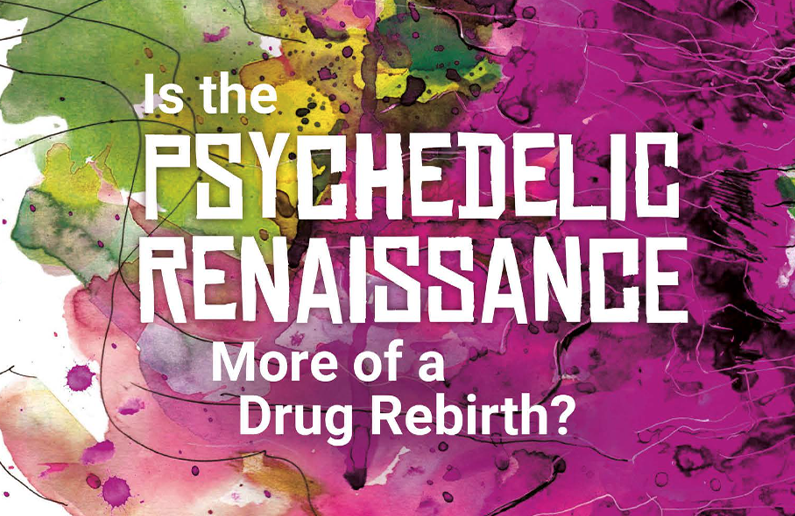
Is the Psychedelic Renaissance more of a Drug Rebirth?, By Paul James
In recent years, there’s been a surge in recreational psychedelic drug use. Alongside this, a number of studies have appeared alluding to the idea that psychedelics may have a use in mental illnesses, particularly depression.
In recent years, there’s been a surge in recreational psychedelic drug use. Alongside this, a number of studies have appeared alluding to the idea that psychedelics may have a use in mental illnesses, particularly depression.
When psychedelics were considered scheduled substances under the Controlled Substance Act in 1970, research largely went dormant. This research would’ve been key to our understanding of drugs like psilocybin (magic mushrooms) and lysergic acid diethylamide (LSD). Instead, we have decades of research to make up for and all-the-while more and more people are getting their hands on these substances and experimenting themselves.
Alongside psychedelics, many are turning to other substances as a means to relieve other health conditions. For example, Kratom has recently garnered popularity for its pain-relieving effects. With that, this “psychedelic renaissance” everyone talks about seems to be geared towards all categories of drugs.
Throughout this article, we’re going to explore the rebirth of psychedelics. Along with the growing number of individuals who are taking health and medicine into their own hands.
The Second Wave of Psychedelics
We’re all aware of the “acid wave” that hit San Francisco and, subsequently, most of the western world in the 1960s. Once the wave broke and rolled back, interest in psychedelic drugs largely diminished. While there was always a culture of Deadheads and late generation hippies, there was never a true rebirth of these substances. That is, until recently.Mental health conditions, such as anxiety and depression, are on a steep rise. According to Western Governors University, only 45% of Generation Z claims to have a healthy mentality.
Compare this to the next closest generation, Millennials, where 56% claimed to have a good mental health standing. ¹Mental illness is on the rise across much of the western world. While there are a number of indicators as to why this is, such discussions will be left for another time as it’s the way young people are tackling these conditions that holds a real interest among both scientists and the public at large.Generally speaking, many Millennials and Gen-Zers have given up on standard western treatments for mental health.
This may be because there’s a growing lack of trust in mental health services² or, more likely, these practices simply haven’t worked for many young people.In turn, they’re turning to a number of substances (both legal and illegal) that have at least some research indicating they may be able to help. Hallucinogens are one of the biggest categories of drugs that has developed such an audience.
Key Issues in Psychedelic Self-Medication
It’s granted that a number of people are finding relief in psychedelics. Whether they’re embarking on an ayahuasca retreat or taking some mushrooms in their backyard, many have found the benefits these substances have to offer.
The difficulty is that there are also a number of people who aren’t taking these drugs properly. For anyone who’s ever embarked on a psychedelic trip, you’re already aware there are a number of things you must do in order to have a good time. Whether it’s being around someone you trust or setting up a calming environment, most psychedelic juggernauts don’t just jump in - they prepare for a good experience.
Furthermore, most of those who have taken psychedelics are already aware of what’s to come when the “peak” of a trip kicks in. They’ve been in that headspace before and, for the most part, know how to handle themselves.
Unfortunately, most of us had to learn such important factors through trial and error. Since these drugs are illegal in most western countries, there are no facilities or services set up to properly teach and guide someone along the psychedelic journey. Instead, most young people are getting a hold of these substances (from who knows where) and throwing themselves into the experience without any sort of precautions.
The dangers in such practice are obvious. Yet, this is exactly what had to happen in order for the public to wake up and realize there may be some value in these substances. Even more so than the public, it’s what had to be done to get scientists interested in researching these drugs again.
What does the ReSearch Say?
As of this time, research is largely limited in terms of psychedelics and mental health. Only recently has public and scientific interest in these drugs started rising. Luckily, there are a number of steps being taken - for example, Johns Hopkins University has opened a Center for Psychedelic and Consciousness Research from $17 million in donations solely from private donors. ³ With that, we can expect more research to appear soon enough.
Until that time, we do have some information confirming psychedelics have potential. ATAI’s investment portfolio company COMPASS has been doing research concerning their psilocybin drug COMP360 and treatment-resistant depression.
They are currently in Phase IIb of their research and chances are they won’t find any approval for their drug until 2026 or 2027.However, early clinical trials revealed that treatment with COMP360 is easy to administer and safe for participants.
In the trial, 89 participants were either given a placebo or 10 to 25 milligrams (mg) of COMP360. Those that received the drug had no negative effects on their cognitive or emotional functioning. The only side effect that was found were changes in sensory perception and mood. Though, considering we’re trying to help people overcome negative perceptions and moods, this isn’t necessarily a bad side effect.
Soon after the test trial, James Rucker, lead researcher, wrote in a company statement: “This is the largest controlled study of psilocybin to date. The results of the study are clinically reassuring and support further development of psilocybin as a treatment for patients with mental health problems that haven’t improved with conventional therapy, such as treatment resistant depression.”5Unfortunately, most of what we know about psychedelics and mental health comes from self-reports.
Take Marc Morgan as an example. As someone who suffered from sexual abuse as a child, he’s developed post-traumatic stress disorder (PTSD). While he attempted traditional treatment, nothing seemed to work. It wasn’t until he took an LSD trip that he was able to process these emotions. Now he takes microdoses regularly and recreational doses once or twice a year.6“It’s basically like taking a cup of coffee,” Morgan told Medical X Press. “You’re just able to be a little more free and a little more honest with your emotions without breaking down. There’s more mental clarity.”
Beyond Psychedelics: The dawn of natural Medicine
While psychedelics have had promising early studies and self-reports, they aren’t the only drugs people have been taking. In fact, there’s been a large culture developing around all-natural medications for a number of different health conditions. This may be part of the reason cannabis and cannabinoids, such as tetrahydrocannabinol (THC) and cannabidiol (CBD), have garnered so much popularity over the last decade.
We can discuss further the issues surrounding mental health and how individuals are using things like kava kava root to help with anxiety or kratom to help them overcome opioid abuse. Or we can discuss physical health conditions like Lyme Disease and how people are using cat’s claw and Japanese knot root to overcome those illnesses.
If you were to Google any health condition alongside “natural remedies,” chances are you’re going to come across a number of protocols people have found useful. And many are diving into these remedies for a few different reasons.
As mentioned, some simply find traditional treatment routes to be ineffective. Or, if they are effective, they come with a number of side effects that end up being worse than the condition itself. However, in places like the United States where the price of healthcare is so high, such alternatives provide a cheaper route.
Even though the Food and Drug Administration (FDA) doesn’t approve of most of these natural remedies, people are going with their guts and taking them anyway. And for this reason, what we’re witnessing goes beyond psychedelics. Truly, we are living through a drug renaissance that goes to all categories of substances. Most of the time, these remedies are paired with a healthy diet and consistent exercise.
So, people are doing more than simply medicating themselves. They’re finding ways to make their overall lives better while fighting particular health conditions. And while this may have big pharma absolutely terrified, it’s bringing a lot of relief to many out there. Of course, there must always be a word of caution when you experiment with all-natural alternatives.
Since these medications aren’t approved by the FDA, there’s usually little research going into their effects. Furthermore, these substances can have negative drug interactions with other substances that we simply don’t know about yet.
Reference Sources1 Western Governors University (WGU): Stress, mental health, and Generation Z. https://www.wgu.edu/blog/stress-mental-health-generation-z1906.html
2 Substance Abuse Treatment, Prevention, and Policy (BMC): Harm Reduction and Tensions in Trust and Distrust in a Mental Health Service: A Qualitative Approach: https://www.ncbi.nlm.nih.gov/pmc/articles/PMC5341417/
3 wbur: How Psychedelic Substances Can Help Treat Anxiety, Depression and Other Mental Illnesses: https://www.wbur.org/hereandnow/2019/10/09/psychedelics-mental-illness-lsd-psilocybin
4 Science & Enterprise: Psychedelic Depression Drug Tested for Safety: https://sciencebusiness.technewslit.com/?p=37938
5 Cision: PR Newswire: COMPASS Pathways and King’s College London Announce Results from Psilocybin Study in Healthy Volunteers: https://www.prnewswire.com/news-releases/compass-pathways-and-kings-college-london-announce-results-from-psilocybin-study-in-healthy-volunteers-300973347.html
6 Medical X Press: Can magic mushrooms and LSD treat depression and anxiety? Scientists are optimistic. https://medicalxpress.com/news/2020-02-magic-mushrooms-lsd-depression-anxiety.html
Written and Published by Paul James in Weed World Magazine issue 152
Image: Originally Unedited Image By Alexandra Haynak



Please complete your information below to login.
Sign In
Create New Account